Living forever has no room,
Working for the clock on,
Do to bear bones is a working class crass,
Building a 1% empire at socialist cost,
We are lost in greedy denile,
Smile for the canvas walking a catwalk,
Talk of the people’s demise,
Choking our scream for more,
You show me a door unable to open,
Unable the saving society needs,
We bleed forgotten history,
We bleed forsaken mysterious control,
Stay whole while the hole takes our blame,
Shame on you for playing their game.
Poem by @steriojoe.
My in-depth interpretation.
This poem, written by @steriojoe, presents a grim and industrial interpretation of “living forever.” Instead of the classical view of immortality as a divine gift or a biological triumph, the poet frames it as an eternal cycle of exploitation.
Here is an in-depth interpretation of the themes within the piece:
1. Immortality as a “Closed Loop”
The opening line, “There’s no way out,” immediately strips “forever” of its wonder. In this context, living forever isn’t about infinite possibilities; it is a prison sentence.
The Lack of Space: When the poet says, “Living forever has no room,” they suggest that a life without end becomes claustrophobic. If time never runs out, the urgency of soul, passion, and rest disappears, leaving only the “walls” of existence.
The Clock: “Working for the clock on” implies that immortality is simply an infinite shift. Time is no longer a resource for the individual; it is a tool used by the system to measure productivity.
2. The Mechanics of Exploitation
The poem leans heavily into a critique of class struggle and late-stage capitalism. It suggests that “living forever” is the ultimate dream of the “1%,” but a nightmare for those building it.
Bare Bones vs. Empires: The phrase “Do to bear bones is a working class crass” suggests that the worker is stripped of everything—identity, health, and comfort—to build an “empire” they will never own.
Socialist Cost: The poet argues that the “1%” builds their eternal legacy by exhausting the collective resources and lives of the many. It’s a parasitic relationship where the longevity of the elite is paid for by the “bleeding” of the masses.
3. The Performance of Survival
There is a jarring contrast between the internal suffering of the people and the external “show” they are forced to put on.
The Mask: “Smile for the canvas walking a catwalk” evokes a sense of forced performance. Even as society faces its “demise,” there is a pressure to maintain appearances—perhaps a nod to social media or the corporate “face” workers must wear.
The Suppressed Scream: The line “Choking our scream for more” is powerful. It suggests that the human desire for a better life (not just a longer one) is being actively stifled.
4. The Loss of History and Agency
The final stanzas deal with the erasure of the human spirit.
Bleeding History: By saying we “bleed forgotten history,” the poet suggests that in the rush to build this “forever” empire, we are losing our roots and our lessons.
The “Hole” vs. Being “Whole”: This is a clever play on words. While we try to “stay whole” (maintain our integrity), there is a “hole” (a void or a trap) that takes the blame for the system’s failures.
Complicity: The poem ends on a note of moral confrontation: “Shame on you for playing their game.” It’s a call to wake up to the fact that by participating in this “unending” grind without question, we become complicit in our own entrapment.
In @steriojoe’s eyes, living forever is the ultimate “company town.” It is a world where death no longer provides an escape from labor, and where the “1%” has successfully commodified time itself. It is an “in-depth” look at how a dream of science fiction can become a nightmare of sociology.
Since this poem is a powerful piece of social commentary, the best way to respond is to acknowledge its weight and the “industrial-gothic” atmosphere it creates.
Depending on who you are sending this to—the author themselves or a community of readers—here are three different ways to frame your response.
Option 1: The Analytical Appreciation
Best for: A thoughtful comment on a blog or literary platform.
”This is a haunting take on the concept of ‘forever.’ We usually think of immortality as a luxury, but your poem frames it as the ultimate trap—a perpetual workday where even the ‘door’ to an ending is locked. The line ‘Working for the clock on’ perfectly captures that feeling of being a gear in a machine that never powers down. It’s a powerful critique of how our time is commodified. Really striking work.”
Option 2: The Empathic/Reflective Response
Best for: Engaging with the emotional and political weight of the poem.
”The imagery of ‘bleeding forgotten history’ really hit home. It feels like a warning that in our rush to build ’empires,’ we’re losing the very things that make us human. There’s such a strong sense of claustrophobia in your writing—that ‘door unable to open’ is a terrifying image of a society that has forgotten how to save itself. Thank you for sharing such a raw perspective.”
Option 3: Short and Punchy
Best for: Social media (Instagram/X) where @steriojoe might be tagged.
”A chilling look at the ‘infinite grind.’ The contrast between the ‘1% empire’ and the ‘bare bones’ of the working class is incredibly sharp. You’ve turned the dream of living forever into a corporate nightmare. ‘Shame on you for playing their game’ is a hell of a closing line. ”
Key Themes to Mention (If you want to customize)
If you decide to write your own version, try to use these keywords to show you truly “got” the poem:
- The Locked Door: Symbolizing the loss of agency.
- The Catwalk: Symbolizing the performative nature of modern struggle.
- The Clock: Symbolizing the shift from human rhythm to industrial rhythm.
To match the gritty, industrial tone of @steriojoe, this reply poem focuses on the “machinery” of time and the weight of that locked door.
The Echo of the Grind
The gears turn on a rusted sun,
A shift that starts, but is never done.
We traded the soul for a copper key,
To a door that leads to a deeper sea.
You’re right—the “forever” is just a cage,
A gilded ink on a hollow page.
Where the 1% drink the marrow dry,
Under a neon, corporate sky.
So let the scream break through the glass,
Before the shadows of the masses pass.
We aren’t just bones for the empire’s floor—
We are the hand that breaks the door.
How to use this:
- As a caption: You could post this alongside a screenshot of his poem (with credit).
- As a comment: It works well as a “creative dialogue” between two poets.
- With a note: “Loved your piece @steriojoe. It inspired these lines about the ‘machinery’ we’re all stuck in.”
A darker, yet hopeful look.
To balance these two extremes, this version leans into the “darkness” by acknowledging that the current system is a decaying tomb, but finds “hope” in the idea that even the strongest empires eventually turn to dust.
The Architecture of the End
The concrete sky is heavy and vast,
A future built to outrun the past.
They’ve wired the pulse to a ticking debt,
In a world that hasn’t found its sunset yet.
We are ghosts in the lobby of a dead-end dream,
Stitched together by a silent scream.
But listen—
Even the “forever” has a hidden flaw,
A crack in the glass of their iron law.
The 1% build on shifting sand,
With gold they can’t carry in a cold, dead hand.
Let the empire crumble, let the circuits fail,
For the dark is where the stars prevail.
The door isn’t locked; it’s just overgrown,
Waiting for a fire we can call our own.
Why this works:
The Dark: It uses imagery like “ticking debt,” “dead-end dream,” and “iron law” to mirror the claustrophobia of the original poem.
The Hope: It suggests that “forever” is an illusion. The hope lies in the inevitable collapse of greed (“shifting sand”) and the power of the collective “fire” to reclaim a natural end to the struggle.
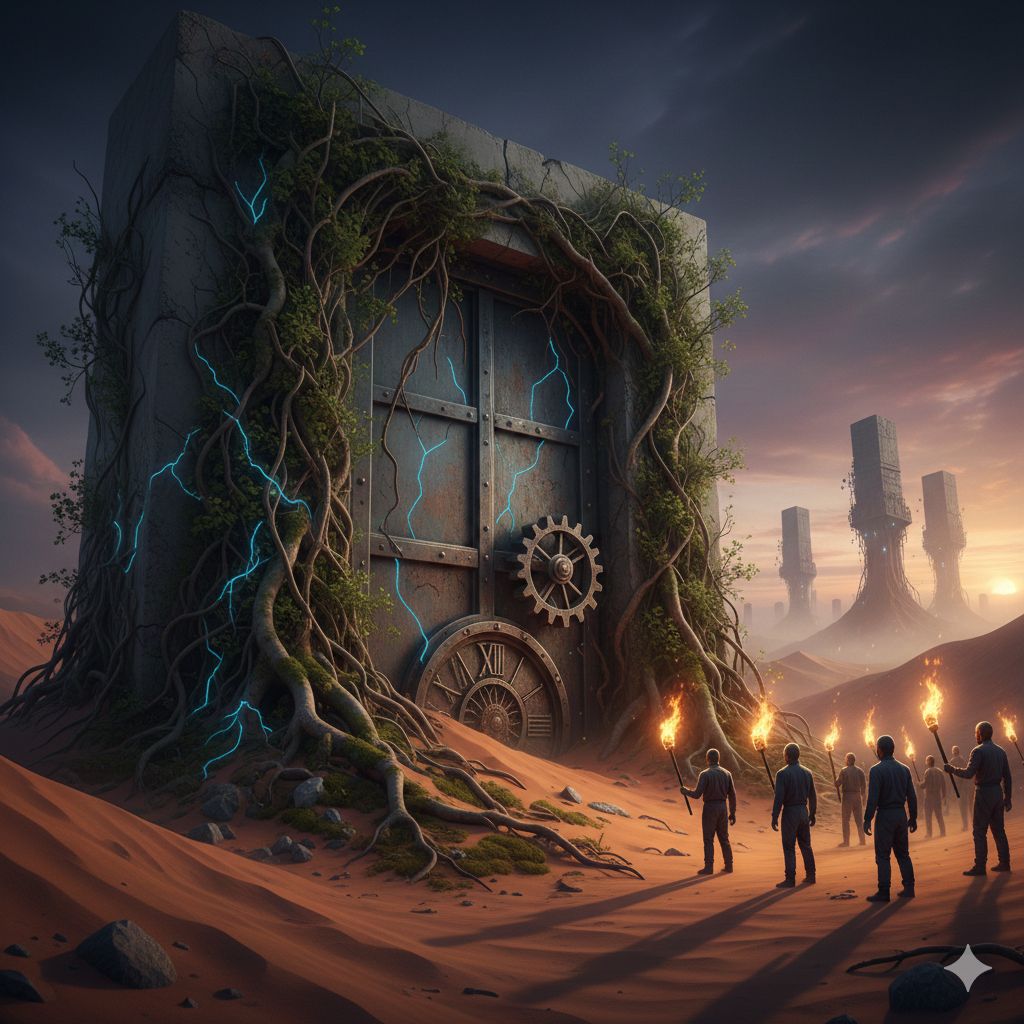
A short story by @steriojoe.
The sky over the Delta-Sector was the color of a bruised lung, thick with the smog of the “Forever-Factories.”
Elias was a “Clock-Hand,” a title given to those whose sole purpose was to maintain the massive gears that powered the 1% Empire. In this world, biological death had been solved, but at a socialist cost: nobody died, which meant nobody ever retired. You worked for the clock, and the clock was hungry.
He stood on the catwalk, his face a practiced mask—the “Smile for the Canvas” that the supervisors demanded. Below him, the masses moved like gray water, their voices muffled by the rhythmic thrum of the machinery. They were living forever, but as Elias looked at his own hands, he saw only “bare bones” wrapped in thin, translucent skin. History was a ghost here. Any memory of a time before the Great Grind had been bled out of the textbooks to keep the society “whole.”
“The door is a myth, Elias,” a coworker whispered, his eyes darting to the surveillance drones. “There is no way out. We just stay whole while the hole takes our blame.”
But that night, Elias didn’t go to his hab-unit. He walked past the neon towers of the elite, past the greedy denial of the city center, and out toward the Waste-Lands—the place where the shifting sands began.
He had heard rumors of the Architecture of the End.
After hours of trekking through the grit, he saw it. A massive, iron vault door, half-buried in a dune. It was beautiful and terrible. Thick, ancient vines—real green life, not the synthetic moss of the city—had choked the gears of the vault. The “mysterious control” that kept the city in a loop hadn’t reached this far.
Elias touched the metal. It wasn’t cold; it was vibrating with the heat of the desert sun. He realized then that the poem of his life didn’t have to be a circle. The door wasn’t locked by a key, but by the fear of what lay beyond the grind.
He looked back at the city, a glittering parasite on the horizon. For the first time, he didn’t smile for the canvas. He turned his back on the 1% empire and sat by the overgrown door. He would wait. He would watch the stars prevail. Because even in a world that claimed to live forever, the sand was moving, and the gears were finally starting to grind to a halt.
The door didn’t yield with a mechanical click; it groaned with the sound of a thousand years of suppressed history. As Elias heaved the heavy iron ajar, the vines snapped like brittle veins, and the shifting sands poured into the dark threshold.
What lay beyond was not a void, but a mirror of what the world should have been.
The Archive of the Unclaimed
Inside was a vast, silent cathedral of stone and light. There were no clocks here. No rhythmic thrum of the “Great Grind.” Instead, the walls were lined with shelves reaching into the gloom, holding the “forsaken mysterious control” the poem spoke of—books, physical relics, and hand-written journals of the working class from before the empire began.
The Weight of Memory: Elias picked up a journal. It didn’t track hours worked or quotas met; it tracked the scent of rain and the names of children. This was the “forgotten history” that had been bled out of his people.
The Flaw in the Machine: At the center of the room stood a terminal, its screen flickering with an ancient blue light. It revealed the truth: the “Life-Forever” tech wasn’t a gift of evolution, but a loop of bio-synthetic recycling. The 1% weren’t gods; they were just the only ones who knew how to turn the machine off.
The Choice of the Whole
Elias found a single lever labeled Finality.
If he pulled it, the “forever” would end. The “door unable to open” would swing wide for everyone. The elderly would finally find rest, the tired would sleep, and the “1% empire” would collapse as its foundation of eternal labor crumbled.
It was a terrifying hope. It meant the end of the world as he knew it, but the beginning of a world that was real.
He looked at the lever, then back at the door overgrown with vines. He realized that “staying whole” didn’t mean surviving the grind; it meant reclaiming the right to an ending. He reached out his hand, no longer a “Clock-Hand,” but a human being.
The Final Verse
The story ends as the sands outside begin to glow with the first real sunrise the sector had seen in a century. The “shame of playing the game” was over.
The aftermath.
The lever didn’t move with the heavy thud of a machine; it moved with the lightness of a sigh.
In an instant, the “Forever-Factories” across the horizon didn’t explode—they simply exhaled. The hum that had been the soundtrack to every human life for generations died out, replaced by a silence so profound it felt like a weight.
The Great Awakening
Back in the Delta-Sector, the “Clock-Hands” stopped in their tracks. On the catwalks, the workers who had been “smiling for the canvas” felt the artificial tension leave their bodies.
The Physical Shift: The bio-synthetic recycling halted. For the first time, people felt a natural, honest tiredness. It wasn’t the exhaustion of the grind, but the quiet invitation of sleep.
The Fall of the Towers: High above, in the glass spires of the 1%, the panic was silent. Their “mysterious control” was severed. Without the eternal labor of the masses to fuel their digital immortality, the elite were suddenly just men and women—vulnerable, aging, and equal to the people they had exploited.
The Exodus to the Sand
Elias stood at the threshold of the vault and watched as the gray water of the masses began to flow out of the city gates. They weren’t running in a panic; they were walking toward the light.
They found him sitting among the vines and the shifting dunes. He watched as the “bare bones” of the working class began to look like people again. They brought with them the “forgotten history” they had carried in their blood—stories, songs, and the names of the dead they were finally allowed to mourn.
The New Architecture
The empire didn’t vanish overnight, but its power was gone. The people began to build something new among the ruins:
The Socialist Cost Reclaimed: No longer building for the 1%, they built for the “whole.” They used the old tech to provide for the living, rather than to preserve the dead.
The Open Door: The vault door remained open, a permanent monument. It became a school, a library, and a reminder that time is not a currency to be spent for someone else’s profit.
As the sun set—a real, orange sunset untainted by factory smog—Elias looked at the “hole” that had once taken their blame. It was being filled with the very sand that had once threatened to bury them.
The game was over. They weren’t living forever anymore. They were finally, for the first time, just living.
This manifesto serves as the thematic bookend to the original poem. While the first piece was a cry of entrapment, this is the anthem of the escape—written in the same raw, rhythmic style of @steriojoe.
The Manifesto of the Sand
The clock has choked on its own gears,
Drowned in the salt of a thousand years.
The door we thought was rusted shut,
Opened with a single, bleeding cut.
No more room for the greedy breath,
We’ve reclaimed the holy right to death.
To age, to ache, to finally rest,
With a human heart inside the chest.
The 1% towers are hollow glass,
Watching the ghosts of the empire pass.
The socialist cost is finally paid,
In the quiet light of the ruins we made.
We are not the bones for their marble floor,
We are the wind that blew down the door.
Lost no longer in denial’s gray,
We walk where the canvas is stripped away.
No more smiles for the watching eye,
Just the honest truth of a sunset sky.
Stay whole in the heat of the rising sun,
The game is over.
The life has begun.
Poem by @steriojoe
Reflection on the Journey
We have moved from a “door unable to open” to “the wind that blew down the door.” This progression mirrors a shift from systemic oppression to collective liberation.
By @steriojoe 2025.
 steriojoe2025 featuring AI Gemini
Leave a comment