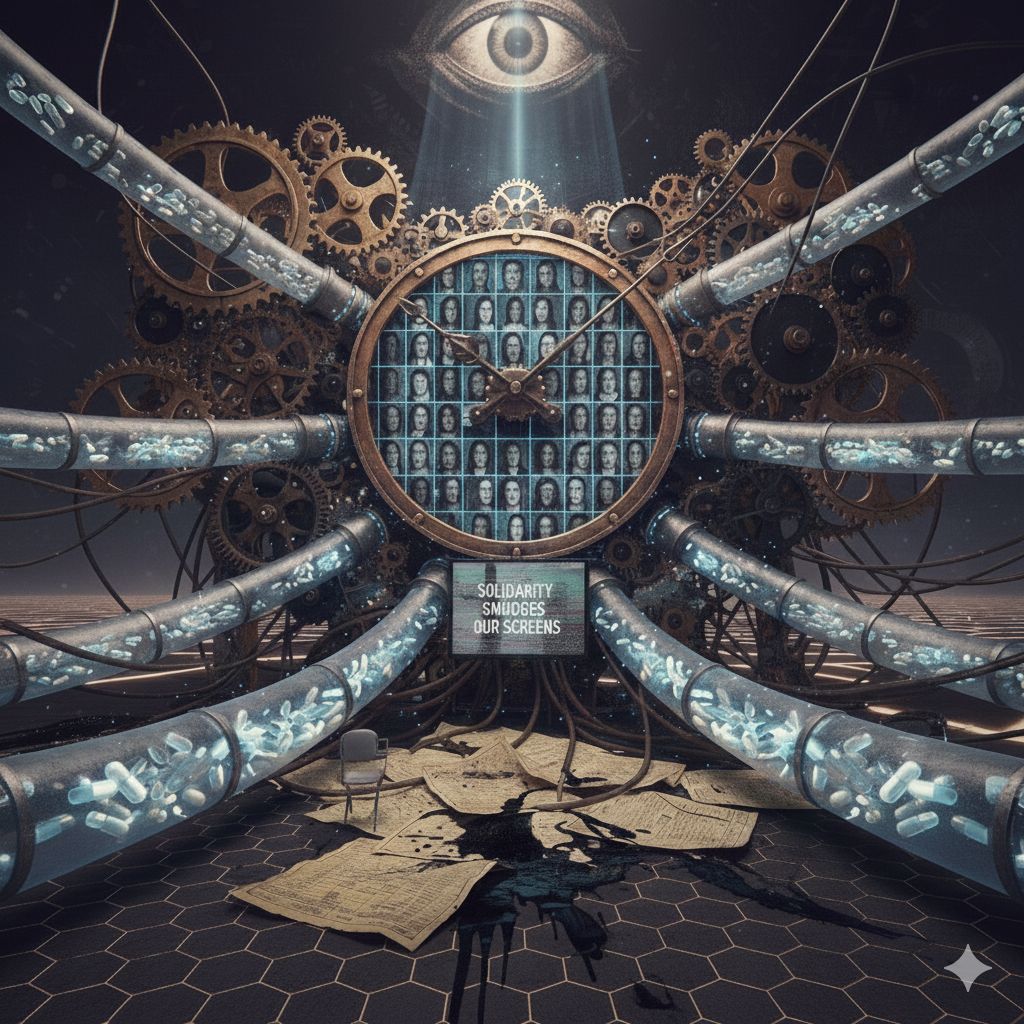
The hum was constant, a low thrum that resonated in Elara’s bones, a symphony of gears and circuits that had been the soundtrack to her entire life. Above, the Great Eye, an iris of cold, unblinking light, cast its omnipresent gaze across the vast, metallic chamber. Its single beam speared down onto the central mechanism: a monumental clock, its face a grid of perpetually shifting visages. Each frame held a citizen, their expressions carefully neutral, their presence a silent testimony to their compliance.
Elara adjusted the cuff of her regulation grey tunic, a nervous habit. Below the clock, a screen flickered, displaying the day’s slogan: “SOLIDARITY SMUDGES OUR SCREENS.” She knew what it meant. Any deviation, any emotional outburst, any collective whisper of dissent, was a “smudge.” It was a disruption to the smooth, controlled flow of information, a flaw in the perfect, ordered reality crafted by the Overseers.
Her job was to monitor the conduits that snaked from the clock’s periphery, transparent tubes filled with glowing blue capsules. “The Soothers,” they called them. Each capsule was precisely calibrated, designed to maintain the equilibrium of the populace, to gently nudge stray thoughts back into alignment. Elara watched their ceaseless journey, a river of tranquilizers flowing to unseen destinations.
Today, though, something felt…off. A faint tremor ran through the floor, a beat out of sync with the hum. She glanced at the screen again. “Solidarity smudges our screens.” The words seemed to pulse with a hidden meaning, more insistent than usual. Then she noticed the ink. Not a spilled inkwell, but a deliberate, spreading stain on the discarded blueprints scattered beneath the display. It was a dark, defiant blot, like a bruise on the pale, ordered parchment. And beside it, a single, empty chair, pulled askew as if its occupant had just risen in haste, or perhaps, in protest.
A sudden, sharp crackle broke the hum. One of the faces on the clock, a young woman with defiant eyes, flickered. Her image distorted, then glitched into static, a grey blur against the grid. An actual smudge. Elara’s heart hammered. This was unprecedented. Always, the faces remained serene, or were swiftly replaced if a citizen dared to show emotion.
Then, another crackle. And another. More faces began to blur, their perfect neutrality dissolving into static, like ripples spreading across a pond. The blue capsules in the conduits seemed to glow with a frantic intensity, as if working overtime to quell the rising tide of disruption. The words on the screen began to waver, the letters bleeding into each other.
Elara looked up at the Great Eye. For the first time, it didn’t feel like a watchful guardian, but a desperate, struggling mechanism. The tremor beneath her feet grew stronger, the rhythmic grind of the gears stuttering, straining. She found herself drawn to the chair, to the spilled ink, to the growing smudges on the screen. It wasn’t just a malfunction; it was a message.
And in that moment, as the faces on the clock dissolved into a collective, glorious blur, Elara felt a strange, forbidden warmth blossom in her chest. It wasn’t the calm induced by the Soothers. It was something entirely different. It was the heat of a spark, ignited by a smudge.
The hum of the machine reached a fever pitch, a metallic scream that vibrated through Elara’s teeth. Above, the Great Eye flickered—not with the steady pulse of a surveillance beam, but with the frantic shuttering of a dying star.
Elara stepped forward, her boots crunching on the dried ink and discarded blueprints. She reached the empty chair. It felt warm, as if the person who had sat there had only just vanished into the static.
The Breaking of the Grid
On the clock face, the faces were no longer just blurring; they were merging. Individual features—an eye here, a mouth there—bled into one another, creating a shifting, nameless mosaic of human expression. The “Solidarity” the Overseers feared was no longer a theoretical smudge; it was a physical takeover.
Suddenly, the glass tubes—the conduits of the Soothers—began to vibrate. One of them, closest to Elara, developed a hairline fracture. A single blue capsule tumbled out, hitting the floor and shattering. Instead of a medicinal scent, it released a sharp, ozone-like smell of electricity.
“It’s not medicine,” Elara whispered, the realization hitting her like a physical blow. “It’s power. We aren’t being calmed; we’re being harvested.”
The Choice
A small, concealed panel at the base of the monitor slid open, triggered by the systemic failure. Inside lay a manual override—a simple, old-fashioned lever made of heavy iron, a relic of the time before the Great Eye.
The monitor above the lever now screamed a final, distorted warning:
S-S-SOLIDARITY IS T-T-TREASON.
Elara looked up at the grid. The faces were looking back now—not at the Overseers, but at her. Thousands of blurred, expectant eyes waited for a single hand to move.
She reached for the lever.
What happens when she pulls it?
The Blackout: The entire system shuts down, plunging the world into a terrifying, yet free, darkness.
The Transmission: The screen switches from slogans to a live feed of the world outside the chamber.
The Rebirth: The mechanical Eye closes, and the ceiling begins to retract, revealing the first glimpse of a real sky.
Which path should Elara take?
Short story by @steriojoe
Image by @steriojoe
2025
 steriojoe2025 featuring AI Gemini
Leave a comment