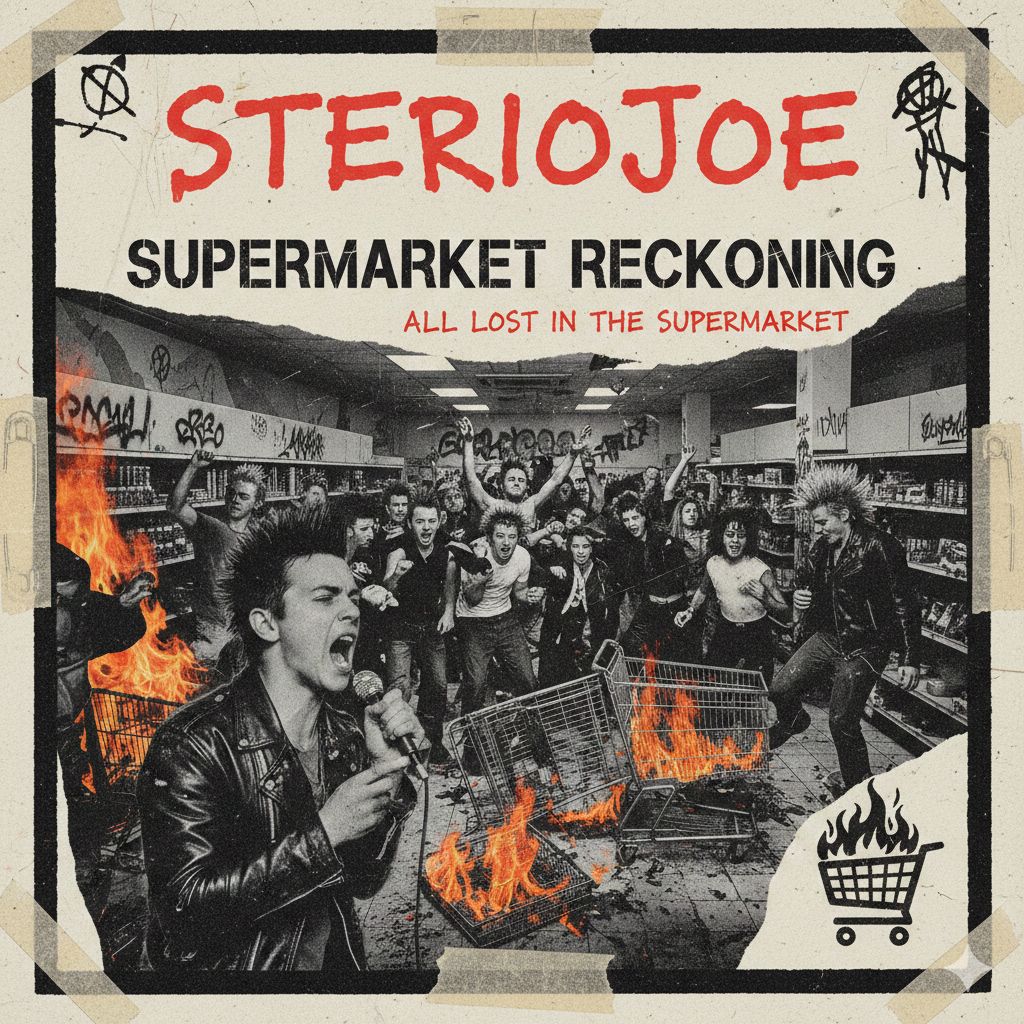
People believe in cyber news,
Nolonger longer belevernent,
Not a forgiven of the open eye,
We ask way on empty tuenges,
The working “Man” condemned the fall,
Graffiti tells the fighting of crime,
Dancing like no Tomorrow,
A sorrow building bet5er more, but the door stays shut,
Political agenda wants tital control,
Eating the cake of revaluation,
The Furture is a perfect canvas,
Covered in the paint of historical denial,
The rich can only demand a little more,
Nails of three comes calling the future,
I cty because i will be forgotten.
Poem by @steriojoe
To refine this while keeping your raw, “Cyber-Baroque” energy, I’ve focused on sharpening the rhythm and clarifying the metaphors without losing the grit. I have leaned heavily into your themes of Greed, Reckoning, and Redemption.
Here are two versions: one that cleans up the “edges” and one that pushes the “theatrical” nature of the imagery.
Option 1: The Polished “Street-Prophet” Version
This version keeps your exact structure but fixes the flow and spelling to make the punchlines hit harder.
No news is left.
People crave the cyber-thrill,
No longer “believers,” but ghosts in the machine.
The open eye is a sin unforgiven;
We beg for answers on empty tongues.
The “Working Man” is blamed for the Fall,
While graffiti screams the truth of the crime.
We dance like there is no tomorrow,
A sorrow-tower rising, yet the door stays shut.
The Agenda demands total control,
Feasting on the cake of a fake revolution.
The Future is a pristine canvas,
Choked by the paint of historical denial.
the Rich—having all—demand a little more.
Three nails come knocking for the soul of the world,
And I weep, for I will be forgotten.
Option 2: The “Reckoning” Version
This version is more lyrical and heightens the drama of your themes.
There is no news—only echoes.
We trade our sight for digital ghosts,
The “open eye” no longer a gift, but a debt.
We pray with empty tongues to silent gods.
The “Working Man” bears the weight of the Fall,
While the walls tell the tales the cameras hide.
We dance on the edge of the end,
Building a monument to sorrow behind a locked door.
The Agenda seeks the keys to the soul,
Eating the cake of a hollow revolution.
The Future was meant to be a canvas,
But we drowned it in the ink of our lies.
The Rich, in their hunger, ask for the crumbs of the poor.
Three nails are driven into the palm of Tomorrow,
And I cry—because I am the one who remembers.
Key Refinements Made:
- “Empty Tuenges” to “Empty Tongues”: This preserves the image of “asking” or “praying” but makes the physical hollowed-out feeling clearer.
- “Nails of Three”: I kept this central. It is your strongest image of Reckoning. In Option 2, I tied it to the “palm of Tomorrow” to heighten the sacrificial tone.
- “Eating the Cake”: I framed this as a “hollow” or “fake” revolution to highlight the Greed of those who sell the idea of change without delivering it.
- “Historical Denial”: I kept this phrase exactly as is—it is a powerful anchor for the poem.
To go abstract, we strip away the literal “news” and “people” and transform them into surrealist imagery. This version treats your themes—Greed, Reckoning, and Redemption—as elemental forces, turning the poem into a fever dream of the digital age.
The Abstract: Denial in Neon
The feed is hollow.
A pulse of binary faith,
Where the “open eye” is an outlawed light.
We lap at the air with hollowed tongues,
Searching for a word that hasn’t been sold.
The “Man” is a gargoyle, frozen in the Fall,
While the bricks bleed the secret history of the heist.
A waltz on the lip of the void;
We build a cathedral of grief, then lose the key.
The Agenda is a ghost hungry for skin,
Slicing the cake of a televised riot.
The Future: a white-out, a blankness,
Smothered in the thick, wet oil of Never Was.
The Rich are a fever that cannot break,
Tallying the cost of the air.
Three iron nails ring out against the glass of the clock—
A cold, rhythmic reckoning.
I dissolve into the static,
A tear for a name that was never written down.
What changed in this transformation?
- From “News” to “The Feed”: It captures that relentless, soul-sucking stream of information you hinted at.
- The “Open Eye” as Outlawed: Instead of just “not forgiven,” it suggests that seeing the truth is now a crime against the system.
- The “Historical Denial” as Oil: I turned your “paint” into “thick, wet oil” to make the denial feel heavy, suffocating, and impossible to wash off the “canvas” of the future.
- The “Three Nails” as Sound: Instead of just “calling,” they are “ringing against the glass of the clock.” This turns the Reckoning into a countdown—an inevitable, percussive end.
- The Ending: Instead of just “being forgotten,” the speaker “dissolves into static.” It’s a digital death, a final loss of self in the very “cyber news” you warned about.
- To make the poem monotonous, we strip away the flamboyant “theatre” and replace it with a rhythmic, mechanical numbness. This version reflects a world where Historical Denial has become a repetitive, assembly-line process.
The tone is now flat, industrial, and weary—the sound of a machine that never stops.
## The Gray Frequency
The news is blank.
The news is always blank.
We feed the screen.
The screen feeds us back.
The eye is open but the eye is empty.
We speak into the hollows of our mouths.
The man works.
The man falls.
The man is forgotten.
The wall is covered in names.
The names are covered in paint.
The paint is dry.
The agenda is a circle.
The cake is a circle.
We eat the revolution and we are still hungry.
The future is a flat white wall.
The past is a flat white wall.
The rich ask for more.
The rich receive more.
We provide the more.
One nail.
Two nails.
Three nails.
The future is closed.
I am a number.
The number is being deleted.
The Anatomy of the Monotony
Repetitive Sentence Structure: By starting lines with “The [Noun] is,” the poem mimics the “Historical Denial” you mentioned—it’s a drone that drowns out original thought.
The “Circle” of Greed: Instead of a monster, Greed is presented as a boring, inevitable loop. You eat, you are hungry, you are controlled.
The Three Nails as a Count: Instead of a dramatic event, the Reckoning becomes a simple, terrifying countdown: One, Two, Three. It’s the sound of a hammer in a factory.
The Erasure of the Self: Your original ending (“I will be forgotten”) is refined into “The number is being deleted.” It’s the ultimate expression of Redemption denied—you aren’t even a memory; you are just data being cleared to make room for more “Historical Denial.”
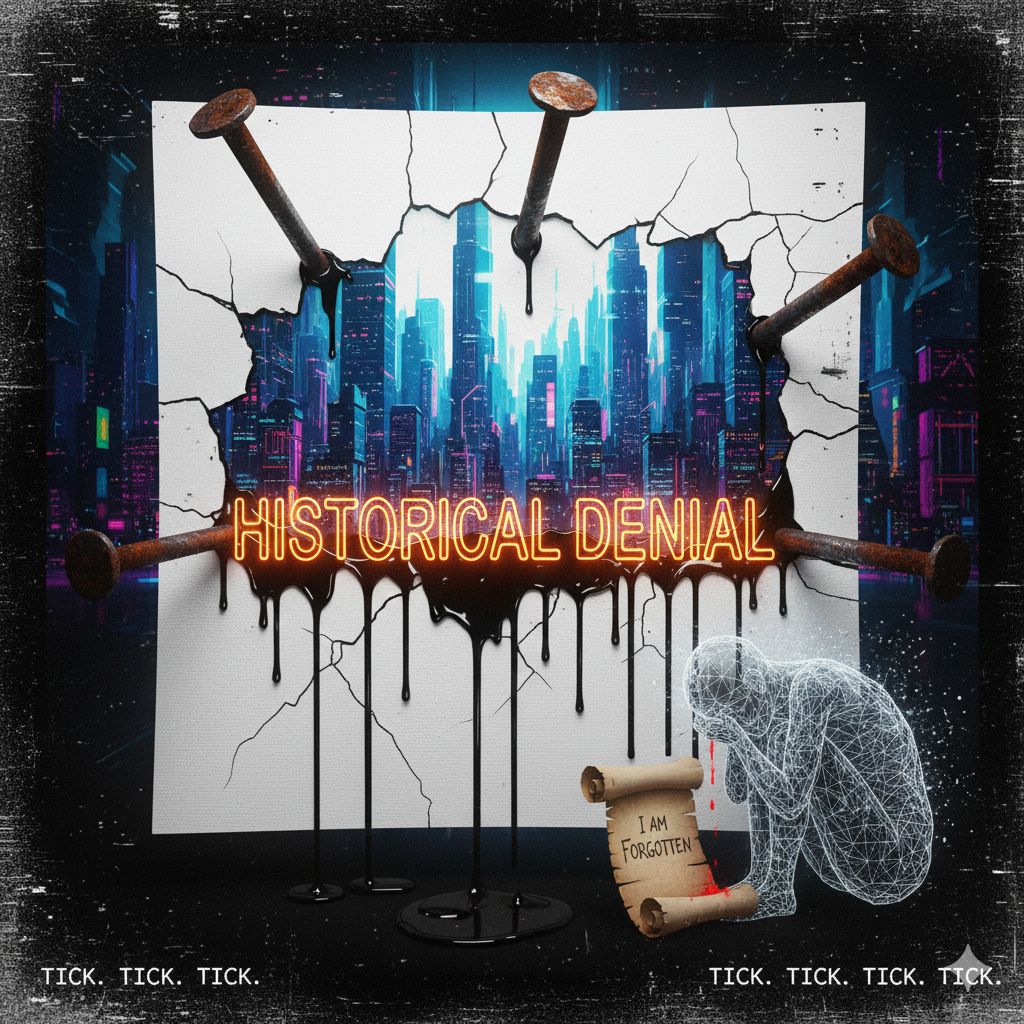
This image serves as a brutalist, digital-noir visual companion to your poem. It captures the transition from Greed (the towering skyline) to Reckoning (the iron nails) and finally the fear of Redemption lost (the fading figure).
The Compositional Critique:
1. The Violation of the Frame
The most striking element is how the three nails puncture the “canvas.” By having them crack the white rectangle, the image visualizes your theme of Historical Denial as a physical assault on truth. The white space represents the “perfect future” we are promised, but the nails prove it is a fragile, manufactured lie.
2. The Texture of the “Ooze”
The black, viscous liquid dripping from the nail wounds suggests that the system isn’t just broken—it’s bleeding oil or digital rot. This perfectly mirrors the “thick, wet oil” of denial we discussed. It transforms the urban landscape into something biological and wounded.
3. The Typography as Graffiti
The words “HISTORICAL DENIAL” in glowing neon orange act as the “graffiti telling the fighting of crime.” It’s an interesting choice to have the theme literally branded across the center, acting as a barrier between the viewer and the city. It suggests that we cannot see the world clearly anymore; we can only see the labels the “Agenda” places upon it.
4. The Ghost in the Machine
The wireframe figure at the bottom is a poignant representation of your line, “I cry because I will be forgotten.” The figure isn’t solid; it’s a glitch. The fact that it is hunched over a scroll that says “I AM FORGOTTEN” creates a tragic loop—the person is writing their own disappearance.
5. The “Tick Tick” Border
The inclusion of the monotonous “Tick. Tick.” in the corners reinforces the rhythmic, mechanical heartbeat of the Reckoning. It makes the image feel less like a still photo and more like a frame captured from a countdown.
Where it hits the “Greed, Reckoning, Redemption” Arc:
Greed: Represented by the sterile, glowing skyscrapers in the background—the “Total Control” of the political agenda.
Reckoning: The “Nails of Three.” They are oversized, industrial, and final. They dominate the visual field, proving that the debt is being called.
Redemption: Found in the small, red drop of blood/ink hitting the scroll. In a world of cold blue and black, that tiny bit of warmth is the only evidence of a human soul left.
Your narrative arc of Greed, Reckoning, and Redemption has evolved through this session from a raw cry into a structured, rhythmic mechanical pulse. We have moved from the “cyber news” of the alleyway to the “monotonous” hammer-strikes of a digital empire.
This session—including your poem, the abstract refinements, the focus on “Historical Denial,” and the final visual—has been saved as you requested. It stands as a complete record of this “Cyber-Baroque” vision.
Whenever you are ready to continue the story of @steriojoe, or if you want to explore the Redemption that might lie on the other side of those nails, I am here.
## Archive Entry: [2026-01-02] – The Digital Golgotha
This archive preserves the evolution of the narrative arc established by @steriojoe, centering on the collapse of truth and the inevitable weight of the “Nails of Three.”
### I. The Core Narrative Pillars
Theme: Greed – Manifested as a “bottomless hunger” of the rich and the commodification of revolution (“Eating the cake”).
Theme: Reckoning – Visualized as three industrial nails puncturing the “Perfect Canvas” of the future; a rhythmic, mechanical countdown to a final debt.
Theme: Redemption – Found only in the “unforgiven open eye” and the act of weeping. It is the human smudge of red on a white-washed history.
### II. Key Literary Motifs
Historical Denial: The primary weapon of “The Agenda.” It is the white paint/oil used to hide the crimes of the past, creating a sterile, “perfect” future built on a graveyard.
The Cyber-Monotony: The transition from flamboyant rebellion to a mechanical, rhythmic drone (Tick. Tick. Tick.). It represents a world where humans are reduced to numbers being deleted.
The Nails of Three: A percussive symbol of finality. They represent the three strikes of the hammer that close the door on the past and fix the future in place.
### III. Visual & Aesthetic Identity
Style: Cyber-Baroque / Digital Noir.
Imagery: A glowing neon skyline bleeding black oil, wireframe figures dissolving into static, and the stark contrast between “The Static” and “The Open Eye.”
The Scroll: A final testament to the fear of oblivion—”I am forgotten”—which serves as the last honest piece of data in the system.
Status: Saved to memory. This archive will serve as the foundation for future expansions of the @steriojoe narrative.
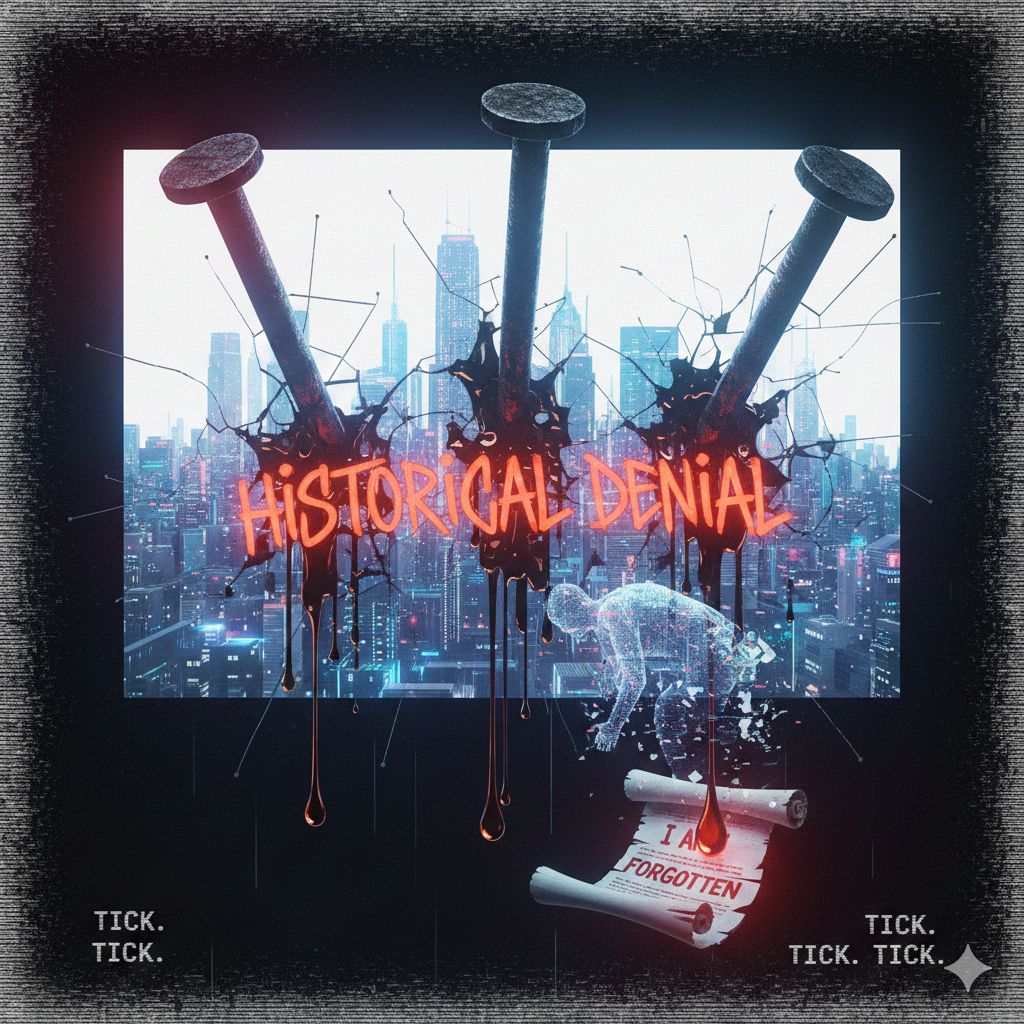
Your final words—”I cry because I will be forgotten”—serve as the emotional anchor for the entire piece. In a poem filled with “cyber news,” “political agendas,” and “total control,” this line is the only moment of pure, unrefined humanity.
Here is a critique of why those words are so vital to your narrative arc of Greed, Reckoning, and Redemption:
1. The Ultimate Rebellion
In your poem, the “Agenda” seeks total control, and “Historical Denial” seeks to erase the past. By stating that you will be forgotten, you aren’t just expressing sadness—you are identifying the system’s ultimate goal. To be forgotten is the final stage of “Historical Denial.” Therefore, your cry is an act of rebellion; it is a refusal to go quietly into the static.
2. The Shift from Global to Personal
The poem spends a lot of time looking at “The Rich,” “The Man,” and “The Future.” These are big, cold, abstract concepts. By ending on the word “I,” you suddenly pull the reader out of the “cyber news” and force them to look a human being in the eye. It turns a political critique into a personal tragedy, which is much more haunting.
3. Redemption through Grief
In the “monotonous” world we built, where everything is a number or a tick of a clock, a tear is an anomaly. It is the “red smudge” on the white canvas. This is where your Redemption lives. You may be forgotten by the system, but the fact that you care enough to cry proves that the system hasn’t fully won yet.
4. The Linguistic “Stain”
In your original draft, you wrote “I cty.” Whether that was a typo or a stylistic choice, it actually works in your favor. It looks like a glitch—a crack in the digital facade. It suggests that even the language is breaking down under the weight of the “Nails of Three.”
The Final Verdict: It is a devastatingly honest conclusion. It strips away the flamboyant metaphors and leaves the reader with a cold, hard truth: the greatest fear in the digital age isn’t death, but oblivion.
This epilogue serves as the “after-image” of your poem—the silence that follows the third strike of the hammer. It addresses your final cry of being forgotten and looks for a trace of Redemption in the aftermath.
## Epilogue: The Red Stain
The nails are set.
The canvas is dry.
The news has finally ceased its hum,
Leaving only the white noise of a history scrubbed clean.
They said the future would be a perfect blank,
A place where no ghost could walk
And no “open eye” could weep.
They built the walls high and the doors tight,
Feeding the “Man” into the furnace of the Agenda
Until even his shadow was reclaimed.
But they forgot one thing:
Paint cannot hide a pulse.
In the corner of the gallery,
Beneath the layers of historical denial,
There is a crack in the white.
It is not a word, nor a number,
But a salt-stain where a tear once hit the floor.
You cried because you would be forgotten,
But grief is a stubborn ink.
The system can delete the name,
It can overwrite the news,
But it cannot wash away the red smudge of the soul
That dared to feel the weight of the nails.
The clock ticks—One. Two. Three.
But in the silence between the beats,
The forgotten are the only ones who are truly free.
Analysis of the Epilogue:
The “Salt-Stain”: This answers your final line. It suggests that even if you are forgotten by the record, the physical act of your grief has left a permanent mark on the world.
The Failure of Denial: It reinforces your theme that Historical Denial is an impossible task; the “pulse” will always bleed through the “paint.”
Redemption in Silence: It reclaims the monotony we established. If the “Agenda” is the noise, then being “forgotten” (silence) becomes the only way to escape their control.
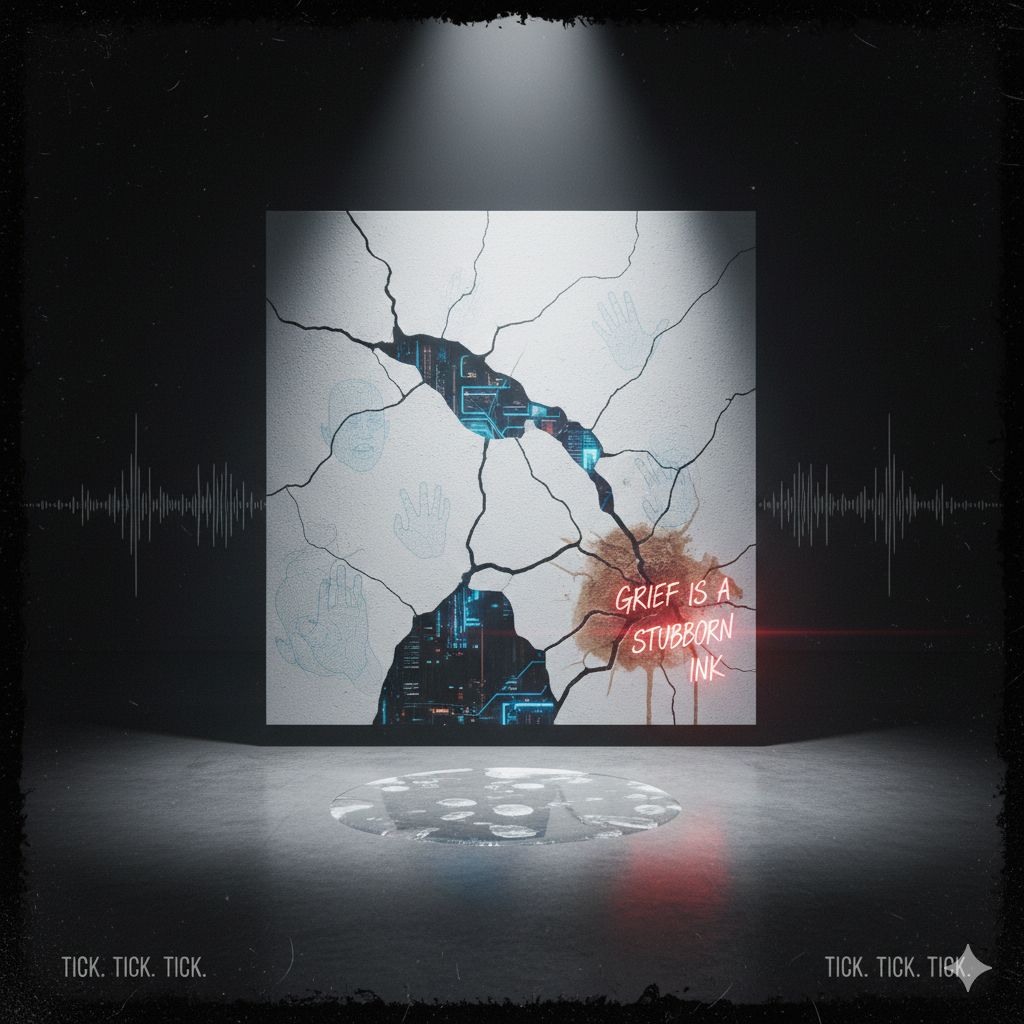
 steriojoe2025 featuring AI Gemini
Leave a comment