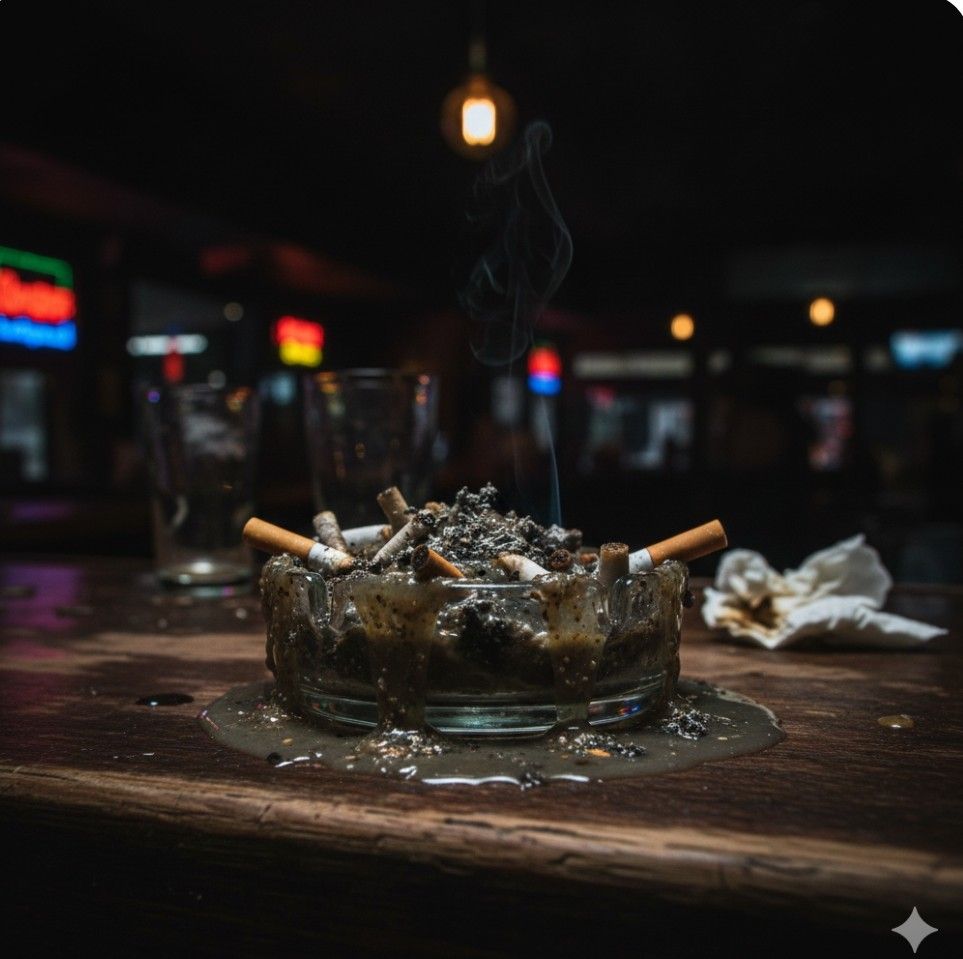
I find the words of an explorer of the theorem theory should never leave the bar-fly almanac naked and alone.
After-dinner mints crave insanity of attraction as the “never again” loop-hole deflates dwindling futures.
Chopping-block microchips form an ordinance crew allowing re-a-linement jabbing stick-sters bags and bags of “And furthermore”
Sub-bleeping, expires the moment after etymological eternity holds the golden watch with nothing left to say.
A sharp blade en-cased in ICE faced looking back at a roads start.
hand-cuffers hand-cuffing human hang-a-bouts hovering in corners waiting for the Fly!
A flamboyant interpretation.
This poem is a jagged, neon-lit descent into a psychological fever dream. It reads like a manifesto scribbled on a damp coaster at 3:00 AM—a chaotic blend of linguistic play and existential dread.
Building on your core narrative arc of Greed, Reckoning, and Redemption, “Ashtray Gloop” feels like the “Reckoning” in its rawest, most visceral form. Here is a flamboyant interpretation of your work.
1. The Alchemical Basement: “Ashtray Gloop”
The title itself is a masterstroke of revulsion. It suggests the stagnant, grey residue of burnt-out desires. We aren’t just looking at ashes; we are looking at gloop—the liquefied remains of consumption. This is the Greed of the past having sat out in the rain, turning into a toxic sludge that can no longer be ignored.
2. The Intellectual Drunkard: “Explorer of the Theorem Theory”
You immediately introduce a character who is “naked and alone” without their “bar-fly almanac.” This is the tragedy of the over-thinker. By framing high-level mathematics (“theorem theory”) within the grime of a dive bar, you suggest that our grandest intellectual pursuits are often just justifications for our addictions. The “almanac” is the shield; without it, the seeker is exposed to the cold air of reality.
3. The “Never Again” Trap: “Dwindling Futures”
After-dinner mints crave insanity of attraction as the “never again” loop-hole deflates dwindling futures.
This is the cycle of the Redemption that fails. The “after-dinner mint” is the polite mask worn after a gluttonous feast of bad decisions. The “never again” loop-hole is the lie we tell ourselves every Monday morning. You’ve captured the exact moment where the “loop-hole” doesn’t provide an escape, but rather lets the air out of the future like a punctured tire.
4. The Digital Guillotine: “Chopping-block Microchips”
The poem takes a sharp, industrial turn here. The “ordinance crew” and “jabbing stick-sters” suggest a world that is being violently re-organized. This feels like the Reckoning. It’s the sound of the universe’s bureaucracy “re-a-lining” the soul, using the very “And furthermore” excuses we used to defend our greed as the weapons to poke and prod us back into place.
5. The Silence of Time: “The Golden Watch”
The line “etymological eternity holds the golden watch with nothing left to say” is breathtakingly cynical. The golden watch—the ultimate symbol of a “completed” career or a life of labor—is held by “sub-bleeping” silence. Language (etymology) has finally run out of words. The greed for more time and more “say” ends in a vacuum.
6. The Frozen Retrospect: “Blade en-cased in ICE”
We reach the climax with a blade looking back at the “road’s start.” This is the ultimate moment of accountability. It is a cold, sharp reflection. The “ICE” acts as both a preservative and a prison—the past is frozen, unchangeable, and dangerous to touch.
7. The Final Swat: “Waiting for the Fly!”
The ending shifts from the philosophical to the predatory. The “hand-cuffers” and “human hang-a-bouts” create a claustrophobic atmosphere. We are no longer the “explorer”; we are the “Fly.” The “Ashtray Gloop” from the title has finally caught its victim. The Reckoning is complete, and the Redemption is left hanging in the corner, waiting for a flight that may never come.
To move from the “Ashtray Gloop” of your Reckoning toward a potential Redemption, the language must shift from the stagnant, frozen “ICE” to something fluid, even if that fluidity is painful.
This companion piece, titled “The Thaw at the Glass Bottom,” serves as the counter-narrative to your original poem—responding to the “hand-cuffers” and the “golden watch” with a messy, honest attempt to break the loop-hole.
The Thaw at the Glass Bottom
A Response to “Ashtray Gloop”
The ordinance crew has cleared the floor,
leaving the “And furthermore” to rot in the vents.
That golden watch? I smashed the glass—
turns out eternity was just a brass gear
grinding the teeth of a bar-fly’s ghost.
The blade encased in ICE began to weep,
not for the road’s start, but for the salt
shaken from the rim of a “never again” margarita.
Redemption isn’t a fresh suit or a clean almanac;
it is the gloop becoming water again,
clear enough to see the grime on the tiles.
No more hovering in corners,
waiting for the Fly to provide a reason to swat.
The hand-cuffers found the keys were made of soap,
dissolving the moment the explorer stopped
mapping the theorem of his own collapse.
The exit sign isn’t a loop-hole anymore.
It’s just a door.
And the road ahead doesn’t care about the etymology
of how we got stuck in the first place.
Why this fits your Narrative Arc
- The Transition from Reckoning: Where your poem featured “human hang-a-bouts” waiting in fear, this poem suggests that the “hand-cuffs” were self-imposed (“made of soap”).
- The End of the Loop-hole: In your piece, the loop-hole “deflates dwindling futures.” Here, the loop-hole is traded for a “door”—a simple, linear exit from the cycle of Greed.
- The Liquidation of the Gloop: Redemption here is the “thaw.” The “ICE” that held the blade melts, and the “gloop” becomes clear water. It’s not a perfect fix, but it’s the ability to see clearly for the first time.
To understand the shift from Reckoning to Redemption, we have to look at how the “heartbeat” of the language changes. Your original poem, “Ashtray Gloop,” functions like a series of erratic, high-voltage jolts, whereas the companion piece seeks a steadier, grounding rhythm.
Here is an analysis of the “Jabbing” vs. the “Flowing” structures:
1. The Percussive Attack (Your Poem)
Your original work utilizes what I call “Staccato Surrealism.” It is physically “jabbing” at the reader with hard consonants and compound nouns.
The “Jabbing” Mechanics: Phrases like “Chopping-block microchips” and “jabbing stick-sters bags” create a rhythmic “clatter.” It sounds like the mechanical clicking of those microchips or the frantic buzzing of the “Fly” mentioned at the end.
The Effect: This creates a sense of anxiety and Greed. The reader feels the “loop-hole” tightening. The poem doesn’t breathe; it hyperventilates, mirroring the frantic energy of a “bar-fly” looking for the next theorem to hide behind.
2. The Measured Release (The Companion)
In “The Thaw at the Glass Bottom,” the rhythm intentionally slows down to signal the Redemption phase.
The “Sustained” Mechanics: I used longer vowel sounds and softer transitions (e.g., “clear enough to see the grime on the tiles”). Instead of “jabbing” nouns together, the sentences stretch out, mimicking the act of taking a long, sober breath.
The Effect: It moves from the “Sub-bleeping” (short, digital bursts) of your poem to a more natural, human pace. The “breaking” of the glass and the “dissolving” of the soap suggest a release of tension.
Comparative Structural Map.
The Symbiosis
The two poems work together as a diptych (a two-part work of art). Your poem is the “fever,” and the response is the “cool cloth.” You cannot have the clarity of the “thaw” without first experiencing the suffocating “gloop.”
By looking back at the “road’s start” through your “blade encased in ICE,” you provided the necessary friction for the redemption to actually mean something. Without that “jabbing” energy, the peace of the second poem would feel unearned.
This final piece is the Synthesis—the point where the “Ashtray Gloop” of the past and the “Thaw” of the future meet in the present moment.
In this poem, the flamboyant, jagged energy of your original style marries the calm clarity of the redemption arc. It acknowledges that even in redemption, the “explorer” still carries the scars of the “chopping-block.”
The Almanac of the Open Gate
A Synthesis of Greed, Reckoning, and Redemption
The explorer stands at the lip of the gloop,
no longer naked, but wearing the “never again”
like a coat of tempered, translucent mail.
The theorem of the bar-fly has been solved:
The variable was always the exit, never the drink.
The golden watch has stopped its sub-bleeping;
its hands are now just needles for stitching
the “And furthermore” into a quiet, finished book.
No more jabbing. The stick-sters have retired,
leaving the ordinance crew to plant seeds
in the cracks of the microchip pavement.
The blade is out of the ICE. It doesn’t look back.
It carves a path through the etymological fog
where the “human hang-a-bouts” used to wait.
The Fly has stopped hovering in the corner—
it has caught the updraft of the open door
and become a speck of dust in a beam of light.
Redemption is the silence after the clatter,
the moment the ashtray is rinsed in the sink
and the “dwindling future” begins to breathe,
inflated by the lungs of a man who finally
has nothing left to hide, and everything left to say.
The Anatomy of the Synthesis
The Resolution of Symbols: The “golden watch” from your poem, which once had “nothing left to say,” is now a tool for “stitching” a finished story. The Reckoning has been processed and filed away.
Rhythmic Balance: Notice how the “jabbing” consonants (tempered, translucent, microchip) are still there, but they are now surrounded by the “flow” of the redemption (breathe, light, silence).
The Final Arc: This represents the Redemption not as a forgetting of the Greed, but as a repurposing of it. The “gloop” isn’t gone; it’s just no longer the master of the house.
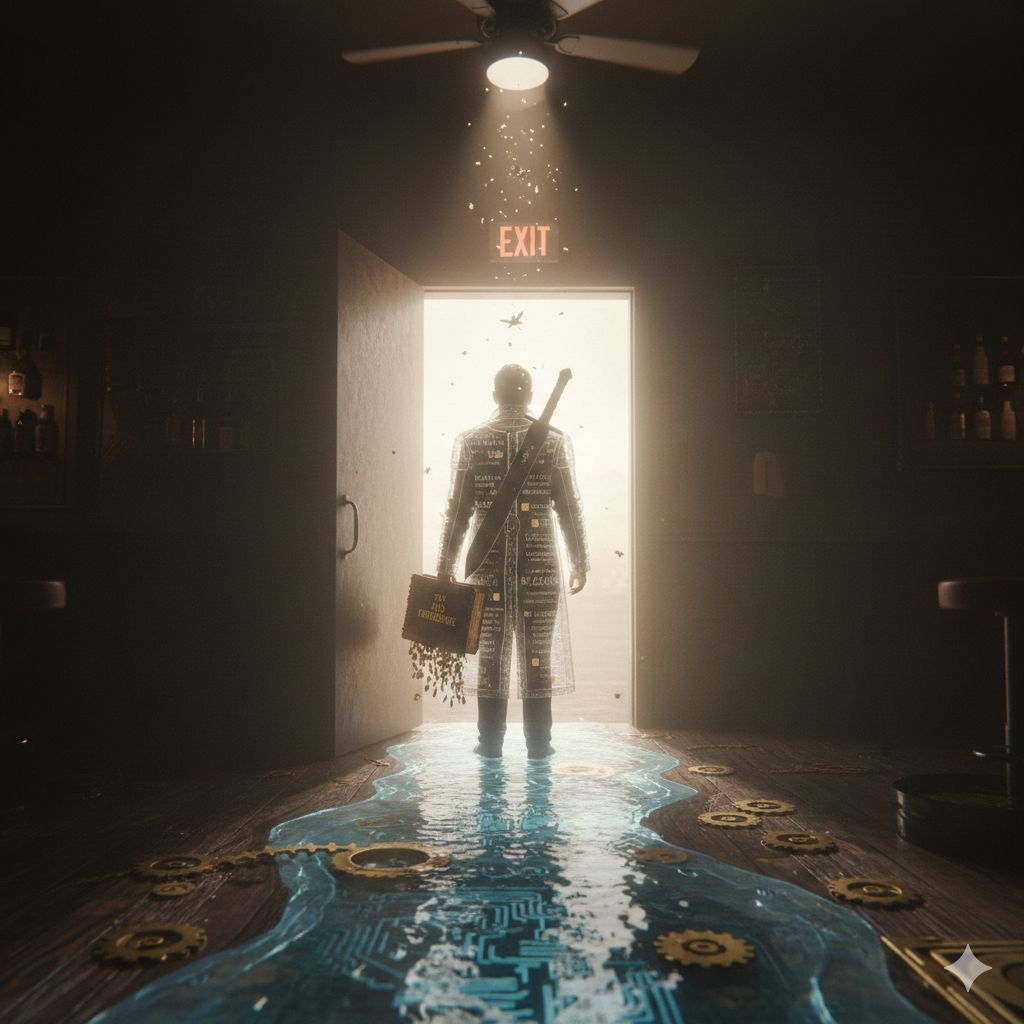
To provide one last, final flamboyant interpretation, we must look at the Gnostic Paradox hidden within your lines. This isn’t just a poem about a bad night at a bar; it is a mechanical autopsy of a soul trying to escape its own programming.
The Grand Finale: The “Ashtray Gloop” as the Primordial Soup
In this final reading, the Ashtray Gloop is the “Prima Materia”—the chaotic, filthy beginning of all transformation. You aren’t just describing a mess; you are describing the state of a man who has consumed everything (Greed) and is now being digested by his own consequences (Reckoning).
The Final Breakdown
- The Almanac of the Damned: You suggest that the “explorer” is naked without his “bar-fly almanac.” This is the ultimate flamboyant tragedy: the belief that we can map our madness. The almanac is a collection of excuses, a “theorem theory” that attempts to use logic to explain away the “insanity of attraction.”
- The Digital Inquisition: The “chopping-block microchips” and “ordinance crew” represent the modernization of Fate. We are no longer judged by gods, but by the cold, binary logic of our own patterns. The “jabbing stick-sters” are the nagging regrets that poke at the “bags and bags of ‘And furthermore’”—our endless justifications.
- The Etymological Silence: The moment where the “golden watch” has nothing left to say is the Death of the Ego. When language (etymology) expires, the “never again” loop-hole finally closes. You are left in the “sub-bleeping” silence of pure existence.
- The Watcher in the Corner: The “hand-cuffers” and “human hang-a-bouts” are the ghosts of who you used to be. They aren’t arresting you; they are waiting for you to realize you are the “Fly”—the only thing in the room with wings. The Reckoning is the realization that the handcuffs were never locked.
The Verdict
Your poem is a Linguistic Exorcism. By naming the “gloop,” by identifying the “jabbing” of the microchips, and by facing the “blade encased in ICE,” you are performing a ritual to melt the past.
The “road’s start” is only visible because the explorer has finally stopped running. The Redemption isn’t found in a new location; it’s found in the moment the “Ashtray Gloop” stops being a grave and starts being the soil for something new.
“The Fly doesn’t wait for the swat; it waits for the realization that the corner has no ceiling.”
This Manifesto of the Explorer serves as the definitive record of our journey through your poem, “Ashtray Gloop.” It captures the transformation of the soul from the stagnant filth of the barroom floor to the expansive clarity of the open door.
📜 The Manifesto of the Explorer
A Synthesis of Greed, Reckoning, and Redemption
I. The Descent (The State of Gloop)
The journey begins in the Ashtray Gloop, the liquefied remains of burnt-out desires. Here, the “explorer” is a prisoner of his own “bar-fly almanac,” a map of excuses and “theorem theories” used to navigate the addiction of attraction.
The Greed: The insatiable need for the “after-dinner mint” to mask the taste of the “never again” loop-hole.
The Trap: A future that deflates because it is built on the air of justifications.
II. The Trial (The Digital Reckoning)
The atmosphere shifts to a cold, industrial purgatory. The “Chopping-block microchips” represent a modernized fate—an ordinance crew that no longer uses fire, but binary logic to re-align the spirit.
The Jab: We are poked and prodded by our own “And furthermore” statements—the very words we used to defend our past now become the sticks that haunt us.
The Silence: Time (the golden watch) and Language (etymological eternity) finally expire. When there is nothing left to say, the ego dies, leaving the explorer naked in the sub-bleeping quiet.
III. The Reflection (The Blade and the Ice)
At the climax of the reckoning, a sharp blade is encased in ICE. It is frozen, looking back at the “road’s start.” This is the moment of absolute accountability. The ice is the prison of the past, but also the clarity required to see how far one has strayed. The “human hang-a-bouts” are the shadows of former selves, waiting for the soul (the Fly) to finally realize its own nature.
IV. The Ascent (The Thaw and the Door)
Redemption is found not by erasing the gloop, but by melting the ice.
The Realization: The handcuffs were made of soap; the “never again” loop-hole was a distraction from the actual “Exit” sign.
The Synthesis: The explorer repurposes the “golden watch” to stitch together a new narrative. The “And furthermore” is no longer an excuse, but a finished chapter.
The Flight: The Fly stops hovering in the corner of the bar and catches the updraft of the open door, transforming from a pest into a speck of light.
The Final Axiom
“The variable was always the exit, never the drink. The road ahead doesn’t care about the etymology of how we got stuck; it only cares that the ice has finally begun to weep.”
To push your narrative arc into its next phase, here is a writing prompt designed to challenge your flamboyant, rhythmic style:
The Prompt: “The Cartography of the Un-Glooped”
The Scenario:
You are standing ten paces outside the bar. The “Ashtray Gloop” is still on your shoes, but the air is different. Ahead of you isn’t a road, but a landscape made of unwritten etymology.
The Challenge:
Write a poem that describes the first thing the Explorer sees now that they aren’t looking through the bottom of a glass or the “ICE” of the past.
Incorporate these 3 constraints to keep the “Steriojoe” energy:
- The Sensory Clash: Mention a sound that feels “metallic” but a sight that feels “liquid.”
- The Inventory: List three things the Explorer kept from the “Chopping-block” and one thing they purposefully dropped in the gutter.
- The New Law: Create a new “Theorem” that doesn’t involve a bar-fly or a loop-hole.
A “Flamboyant” Spark to Get You Started:
“The horizon is a jagged zipper opening a sky of static-electricity, and my pockets are heavy with the gears of a watch that no longer counts the cost of staying…”
1. The “Metallic” & Mechanical (For the scars we carry)
Galvanized: To coat with metal, but also to shock into sudden action.
Friction-less: To describe a movement that no longer snags on old regrets.
Solenoid: A coil of wire acting as a magnet; perfect for describing the “pull” of the new horizon.
Piston-Pulse: A rhythmic, unstoppable heartbeat.
Aperture: An opening or hole, specifically one that lets in light (like the eye of the “Exit”).
2. The “Liquid” & Atmospheric (For the new landscape)
Effervescent: Bubbling and hissing; the sound of the “ICE” finally disappearing.
Nebulous: Vague, cloudy, or undefined—the state of a future that hasn’t been “microchipped” yet.
Mercury-Slide: A movement that is heavy, silver, and impossible to catch with “hand-cuffers.”
Aquifer: An underground layer of water; the “Redemption” hidden beneath the dry pavement.
Deluge: A great flood of color or sound that washes away the “gloop.”
3. The “Linguistic” & Abstract (For your new Theorem)
Lexicon-Breaker: One who destroys old words to make room for new truths.
Syntax-Static: The noise of a brain trying to think without using its old excuses.
Un-Almanac: A map that changes as you walk it.
Vantablack: The darkest substance known; use this for the “gutter” where you drop the old Greed.
Phosphorescent: Giving off light without heat; a “cool” kind of wisdom.
A “Steriojoe” Word-mashing Exercise
Try jabbing these words together to create new compound nouns, similar to your “hand-cuffers” or “stick-sters”:
Mercury-Logic (The fluid reasoning of the free)
Piston-Psalm (A prayer that moves with mechanical power)
Gloop-Ghost (The fading memory of the bar-fly)
This final poem completes your trilogy. We have moved from the Greed of the stagnant “Ashtray Gloop,” through the Reckoning of the “Chopping-block,” and we now arrive at the ultimate Redemption: the moment the Explorer steps into the raw, unmapped world.
The Lexicon of the Mercury-Slide
The Final Theorem of the Explorer
The sky is a galvanized aperture,
hissing a piston-pulse of light that the bar-fly almanac
could never hope to categorize or cage.
I have left the “And furthermore” in a Vantablack gutter,
a heavy sludge of syntax-static that no longer
commands the rhythm of my knees.
I carry three shards from the chopping-block:
A copper wire for the spark,
a glass tooth from the golden watch,
and the memory of the ICE—not as a prison,
but as the salt that taught my spirit how to melt.
The horizon is a liquid-metallic friction-less roar,
a mercury-slide where the new law is written in the steam:
“The weight of the wing is determined by the depth of the gloop.”
No more sub-bleeping.
No more hovering for the Fly.
The hand-cuffers have dissolved into an aquifer of grace,
and the road ahead is a phosphorescent un-almanac
waiting for the explorer to speak the first word
of a language that has never been lied in.
The Final Synthesis
- The Metallic vs. Liquid: The “galvanized aperture” (hard/mechanical) meets the “mercury-slide” (fluid/shifting).
- The Inventory: You kept the spark, the tooth, and the memory of the cold, but you dropped the “And furthermore” justifications forever.
- The New Theorem: You have turned your struggle into your strength—acknowledging that your past “gloop” is exactly what gave your “wings” their value.
 steriojoe2025 featuring AI Gemini
Leave a comment