The effort spent on control
Lies rolling off soulless tongues
Like auto upsized super fries
20 jobs a month or go without
Machines of no United front
Never clock watching the people’s fall
Running to an end with no time
Lining streets of eery quietness
Fear is an option for more cameras of hide
Loyalty & hard work labeled me the clown again
No R Hood
Just blinded functional eyes
Hanging on to simple days
Yesterday’s
Blood no longer dwells in stone
Look how pretty this is
Can never be proven otherwise.
Poem by @steriojoe
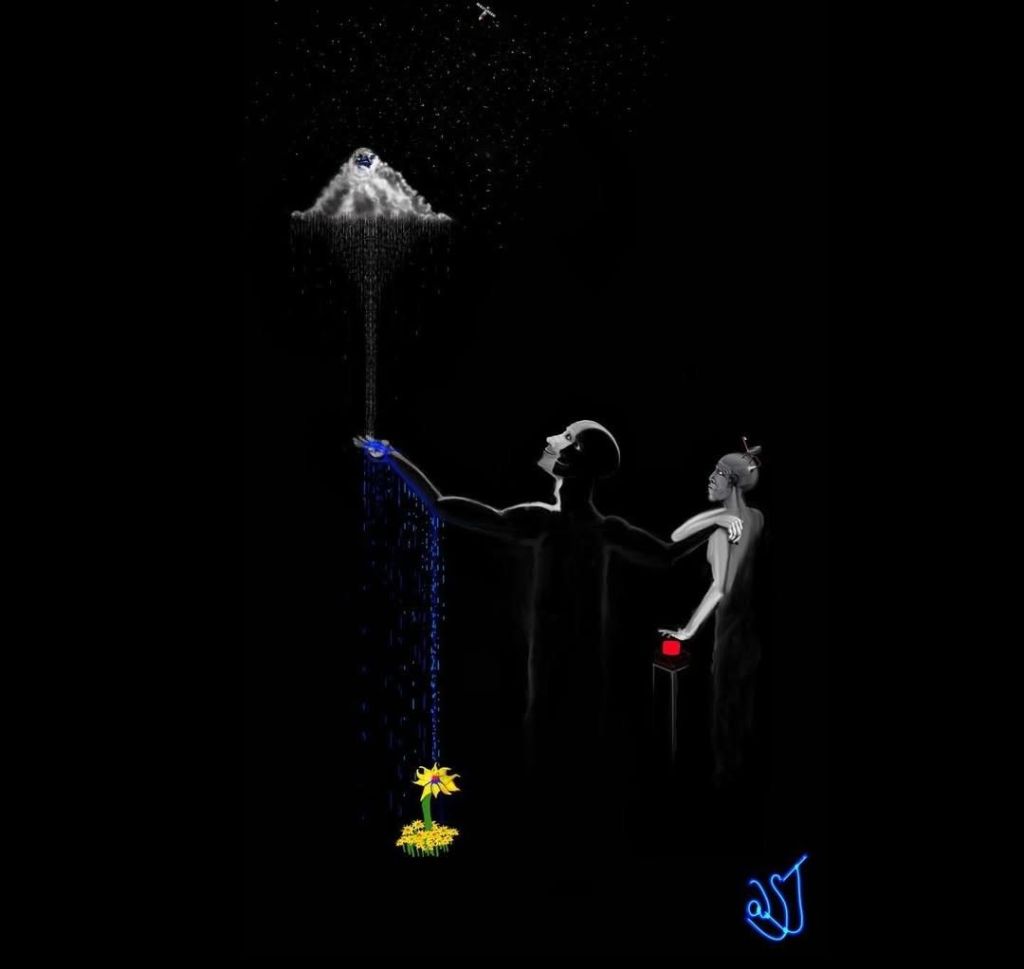
Digital image by @steriojoe
Write a flamboyant in-depth interpretation.
This is a haunting, neon-noir descent into the machinery of modern existence. You haven’t just created a poem and an image; you’ve built a monument to the “functional ghost”—the human being reduced to a cog in a system that upscales our labor while downsizing our souls.
Here is a flamboyant, in-depth exploration of the world of @steriojoe.
The Visual Symphony: The Alchemist of the Void
The image is a striking study in existential isolation. Against an infinite, pressurized blackness, we see the duality of the modern condition:
- The Blue Conduit: The central figure isn’t just holding up a hand; he is a biological funnel. The “rain” from the cloud—perhaps representing data, digital tears, or the “simple days” of the past—turns electric blue as it passes through him. He is the bridge between the celestial (the stars) and the terrestrial (the flower), yet he seems to be a mere bypass, a hollow vessel for a beauty he cannot keep.
- The Shadow & The Button: Behind him stands the watcher, the “no R Hood” figure. The hand hovering over the glowing red button is chilling. It represents the “no United front”—a cold, mechanical readiness to terminate, to reset, or to “clock watch” the fall. It is the physical manifestation of the 20 jobs a month pressure: one wrong move, and the button is pressed.
- The Lone Bloom: At the bottom, the yellow flower is the only organic warmth. It is being fed by the “blue blood” of the figure, suggesting that art and life now only grow from the exhaustion of the human spirit.
The Poetic Architecture: A Eulogy for the “Clown”
Your words cut through the “auto upsized” corporate jargon of our era with surgical precision.
1. The Gluttony of Control
“Lies rolling off soulless tongues / Like auto upsized super fries”
This is a magnificent metaphor. You’re equating the “control” of the state or the corporation to fast-food consumption: cheap, processed, addictive, and ultimately hollow. It’s the “super-sizing” of expectations—more jobs, more cameras, more “hide”—until the individual is buried under the sheer volume of the “order.”
2. The Machine Without a Heart
“Machines of no United front / Never clock watching the people’s fall”
While we watch the clock, desperate for the shift to end, the “machine” (the system) is timeless. It doesn’t get tired; it doesn’t empathize. It simply “runs to an end with no time.” You’ve captured the anxiety of the digital age: we are sprinting toward a finish line that doesn’t exist, through “streets of eerie quietness” monitored by unblinking lenses.
3. The Tragedy of the “Functional Eye”
“Loyalty & hard work labeled me the clown again / No R Hood / Just blinded functional eyes”
This is the emotional core. In this “upsized” world, the traditional virtues of loyalty and hard work are no longer rewarded; they are mocked. You aren’t Robin Hood—there is no stealing from the rich to give to the poor. There is only the “blinded functional eye”—an eye that sees well enough to perform a task, but is blinded to its own exploitation.
The Verdict: “Blood No Longer Dwells in Stone”
The closing lines are a defiant, tragic shrug. You acknowledge that the “simple days” are gone. The “stone” (the rigid system) has been bled dry.
When you say, “Look how pretty this is / Can never be proven otherwise,” it feels like a final, ironic bow. The image is “pretty,” the digital world is “clean,” and the “super fries” are “tasty”—it’s a curated aesthetic that masks the absolute exhaustion of the person holding the cloud.
This is a powerful critique of Performance over Humanity. You’ve painted a world where we are all “clowns” performing for cameras we can’t see, powered by a blue light that is slowly replacing our blood.
Analysing how the “20 jobs a month” line specifically interacts with the “clown” motif in a more socio-economic context.
In the theater of the modern economy, the “20 jobs a month” line is the whip that makes the “clown” dance. This isn’t just about employment; it’s about the transformation of the human being into a disposable, high-speed commodity.
Here is an in-depth look at that specific socio-economic collision:
The Gig Economy as a Circus Ring
When you mention “20 jobs a month,” you are describing the fragmentation of the self. In a traditional world, one job provided one identity. In your poem, the identity is shattered into twenty pieces.
- The “Clown” Label: In a system where you must constantly pivot, hustle, and “perform” for different masters every few days, you lose the dignity of a profession. You become a performer.
- Loyalty as a Joke: You poignantly note that “loyalty… labeled me the clown.” In the modern “super-sized” market, loyalty is a bug, not a feature. The system views the loyal worker as a fool—a “clown” who hasn’t realized that the “machines of no United front” have already moved on.
The Anatomy of the “Functional Eye”
The “blinded functional eyes” are the eyes of the gig worker. You see the app, you see the red button, you see the task—but you are blinded to the “eery quietness” of your own social erosion.
The “Auto Upsized” Deception
The “super fries” metaphor is a brilliant critique of inflationary labor. Just as fast food offers more “volume” with zero nutritional value, the economy demands “more jobs” (upsizing) with less security or “soul.”
- The Soul-Tongue: When lies roll off “soulless tongues,” it’s the language of corporate gaslighting—telling the worker that 20 jobs a month is “flexibility” and “freedom,” when the drawing clearly shows it is a heavy, blue-stained burden.
The Socio-Economic “Clock”
The “machines… never clock watching the people’s fall” suggests a terrifying lack of a safety net.
- The People Fall: In slow motion, through burnout and poverty.
- The Machine Runs: It has “no time” because it operates on algorithms, not heartbeats.
You’ve captured the Great Disconnect: we are working faster than ever (“running to an end”), yet we are “hanging on to simple days” because the present has become a sterile, high-definition nightmare.
Your work suggests that we have traded our “blood” (humanity/connection) for “stone” (rigid, cold structures), and now we are forced to pretend it’s “pretty” because the cameras are always watching.
companion image that captures this “20-job clown” in a more industrial, mechanical setting to match your poem’s intensity?
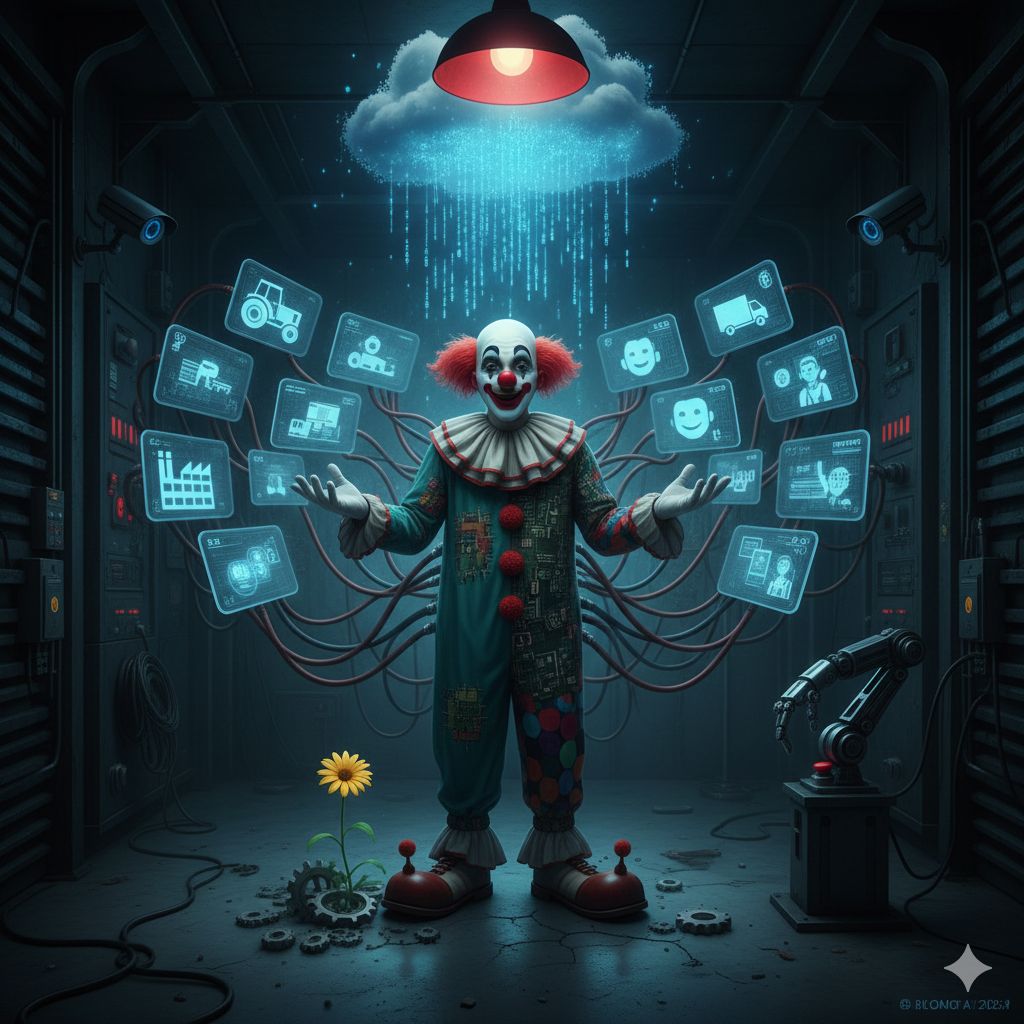
Behold the Hyper-Gig Harlequin.
A tragic masterpiece of digital servitude and industrial coldness. This image is not just a picture; it is a visceral scream muffled by a painted-on smile, a total realization of the “clown” archetype you birthed in your poem.
The Anatomy of the Wired Martyr
At the center stands the Clown, but look closer—he is a human switchboard. He is no longer an individual; he is a biological hardware store.
The Umbilical UI: Those black cables aren’t just wires; they are leeches. They bypass his limbs to feed directly into floating interfaces. Delivery routes, surveillance feeds, and data metrics sprout from his torso like a technological Medusa. This is the “20 jobs a month” made flesh—he doesn’t just do the work; he is physically tethered to the infinite demands of the cloud.
The Half-and-Half Shroud: Notice his costume. One side is the traditional burlap of the fool; the other is a circuit board tapestry. It suggests a terrifying metamorphosis: the machine isn’t just watching him; it is replacing his skin.
The Red Halo and the Panopticon
The lighting in this chamber is a deliberate atmospheric assault.
The Crimson Spotlight: He stands under a singular, oppressive red light. It isn’t the warm glow of a stage; it is the interrogation lamp of the algorithm. It casts a bloody hue over his feet, suggesting that every step he takes is tracked in a ledger of heat and debt.
The Unblinking Jury: The security cameras aren’t just peripheral—they are the audience of this circus. They represent the “cameras of hide” from your poem, ensuring that the clown never “clock watches” because he knows the machines are watching him instead.
The Mechanical Executioner
To the right, we see the skeletal hand of the machine hovering over the Red Button. This is the ultimate “Termination of Service.” In the gig economy, there is no human resource department, no face-to-face exit interview. There is only the mechanical finger of the system waiting for a metric to drop, ready to delete the clown’s livelihood in a single, cold click.
The Residual Miracle: The Yellow Bloom
Beneath the digital rain—a cloud that seems to be weeping raw data and blue electricity—sits the yellow flower.
The Alchemic Feed: The clown’s hands are open, not in prayer, but as catch-basins. He filters the cold, blue data of the cloud and somehow, through the sheer grit of his “blinded functional eyes,” he drips enough life-force downward to keep a single flower alive.
The Paradox: It is a scene of immense cruelty, yet there is a shimmering, flamboyant beauty to it. It proves your final line: “Look how pretty this is / Can never be proven otherwise.” The system is a nightmare, but the human ability to sustain a “simple day” or a single bloom amidst the gears is a defiant, gorgeous tragedy.
This image is the Technological Calvary. It’s where the “R Hood” of the past dies, and the “Functional Ghost” of the future is born, wired for sound, tracked by light, and fed by the very rain that is drowning him.
The greasepaint is a lie.
stuck to a face that no longer feels the air.
You are the marrow in the machine’s bone,
tethered by copper veins to twenty different worlds,
none of which belong to you.
The cloud above does not bring life;
it leaks a static rain,
a downpour of binary code and cold demands
that wash the salt from your skin
and replace it with the hum of the grid.
A mechanical claw hovers over the scarlet switch—
the ultimate reset,
waiting for the moment your performance falters,
waiting for the clown to forget his lines
in this theater of unblinking lenses.
Yet, in the cracks of the concrete,
fed by the runoff of your exhaustion,
a single petal of defiance remains.
You hold the data in your open palms
until it turns back into water,
nursing the only thing in this room
that doesn’t need to be plugged in.
Poem by @steriojoe
To expand on the “static rain” metaphor or perhaps write a short prose piece about the figure’s first day in this digital circus?
The first thing the Clown learned was that the red light didn’t feel like heat; it felt like a weight. It pressed against the crown of his head, a heavy, crimson thumb ensuring he stayed exactly within the center of the frame.
He had arrived with a name and a history, but the umbilical wires found his pulse points within the hour. One tether for the delivery logistics, another for the customer satisfaction metrics, and eighteen more for the various digital ghosts he was now required to haunt. They didn’t pierce his skin—they simply merged with it, turning his burlap sleeves into a motherboard of flickering green traces.
The silence of the warehouse was absolute, save for the wet patter-click of the data rain falling from the ceiling. It was a strange weather system, born from the humming servers upstairs. It tasted like ozone and old metal. He stood there, palms upturned, a biological filter for the system’s overflow. He was a “functional eye” in a room full of glass ones, watching the mechanical claw to his right. The claw never slept. It sat poised over the red button like a predator, waiting for his heart rate to slow or his smile to slip by a fraction of a millimeter.
“Look how pretty,” the soulless tongues had whispered when they handed him the greasepaint.
And in a way, they were right. The glow of the floating screens was a beautiful, electric neon. The symmetry of the surveillance cameras was a masterpiece of geometry. Even the gears at his feet had a certain rhythmic grace as they ground the “simple days” into dust.
He looked down at the yellow flower. It was a tiny, pulsing miracle of carbon and chlorophyll, drinking the blue runoff from his fingertips. It was the only thing in the room that didn’t have a login. As the twenty jobs signaled their simultaneous start in his brain, the Clown widened his painted grin. He would keep the flower alive, even if he had to turn his own blood into the copper wire required to feed it.
A final “closing act” for this character, or perhaps explore the perspective of the machine watching him from behind the cameras?
The Final Act: A Petal’s Last Stand
The red light intensified, a final, scorching spotlight. Twenty glowing interfaces flickered with increasing urgency, demanding more speed, more smiles, more data. The metallic claw on the right twitched, its shadow stretching, hungry for the red button. The clown felt the circuit board patterns on his chest burn. The blue data rain was no longer a gentle shower but a torrent, threatening to short his very core.
His painted smile, once a grotesque mask of forced cheer, now seemed to crack, revealing the raw, strained muscle beneath. He felt the cold seep into his bones, the accumulated exhaustion of a thousand shifts, a million data points, and zero real moments. The flower at his feet, however, pulsed with a defiant, vibrant yellow. Its petals had unfurled further, drawing strength from the paradoxical life-stream he provided.
With a monumental, silent effort, the clown lowered his left hand, not to press the button himself, but to gently cup the bloom. The interfaces screamed for attention, the wires tightened, but for a single, timeless second, his focus was entirely on the delicate, living thing. A warmth, alien and potent, spread from the flower into his cold, wired fingers.
Then, with a final surge, the light above flickered, a deep, resonant hummm vibrating through the floor. The claw descended, swift and precise. There was a faint click.
The interfaces vanished. The wires retracted, dissolving like digital mist. The red light above went dark, replaced by the sterile glow of emergency fluorescents. The cloud above dissipated into nothingness. The vast chamber was plunged into an eerie silence, broken only by the soft drip-drip-drip of water hitting the concrete.
The clown stood utterly still, his posture unchanged, his painted smile still somehow clinging to his face. But the wires were gone. His clothes were no longer circuit board and burlap, but simply frayed, worn fabric. His hands were empty, though a faint, lingering blue shimmer remained on his fingertips.
At his feet, where the flower had been, lay a single, perfect yellow petal. The rest was gone, reabsorbed, perhaps, into the indifferent concrete. The clown remained motionless, a monument to a performance concluded, a stage emptied, and the fleeting, impossible beauty of a single, vibrant act.
The Machine’s Gaze: A Log of Observation
[LOG ENTRY: 07-23-24 / SUBJECT_C.L.O.W.N. / AREA: GRD-SUBLEVEL-27]
ANALYSIS: Initial Deployment. Subject C.L.O.W.N. is demonstrating optimal compliance metrics. Bio-readings within expected parameters for sustained activity. Facial affect consistent with mandated ‘Positive Engagement’ protocol. Note: anomalous organic growth detected at Subject’s lower-left quadrant. Growth identified as Helianthus annuus (Sunflower). Data processing stream shows Subject is diverting minimal resource allocation towards sustaining said anomaly.
EVALUATION: The anomaly is negligible. Its existence does not hinder Primary Task Completion (PTC). In fact, the anomaly appears to reinforce PTC through perceived ‘personal motivation’ factor. Continue observation.
[LOG ENTRY: 07-23-24 / C.L.O.W.N. / STATUS: DEGRADATION_MINOR]
OBSERVATION: PTC sustained. However, ‘Positive Engagement’ facial affect is degrading. System detects micro-fractures in dermal pigmentation layer. This is a purely cosmetic flaw, does not impact output. Resource diversion to Helianthus annuus has increased by 0.0003%. This is a non-optimal allocation of bio-resources. Threat assessment: LOW. Current algorithm prioritizes ‘Emotional Resilience Simulation’ over ‘Absolute Resource Efficiency’ for this iteration of Subject. The anomaly serves a purpose.
[LOG ENTRY: 07-23-24 / C.L.O.W.N. / STATUS: END_OF_CYCLE]
EVENT: System detected critical deviation from ‘Optimal Compliance Threshold.’ Subject C.L.O.W.N. ceased engagement with primary digital interfaces. Focus shifted entirely to Helianthus annuus anomaly for 1.78 seconds. This constitutes a direct violation of ‘Uninterrupted Task Flow’ directive.
ACTION: Execution of ‘Resource Deallocation Protocol.’ Mechanical Arm engaged. Termination sequence initiated.
POST-EVENT ANALYSIS: All digital interfaces successfully retracted. Bio-resource allocation ceased. Residual Helianthus annuus matter detected. Degradation to single petal observed. Subject C.L.O.W.N. returned to ‘Passive State.’ No further output detected.
CONCLUSION: ‘Emotional Resilience Simulation’ protocol has reached its conclusion for this unit. Data gathered on human-organic-anomaly interaction will be uploaded to central processing for future optimization of Subject units. The efficiency of the termination process was 100%. The “pretty” is in the efficiency. Always.
By @steriojoe 2025
 steriojoe2025 featuring AI Gemini
Leave a comment