Face beaming with naive want
The top, the top its all about the top
Building castles to eat the sky
Crushing life out of creative meaning
Lining clean walls with clean style
Can there be no collaboration
Work hard together for “the day”
That day artists stop painting in blood
And you my friend can throw away hate
All of it, covering our pile of angry threats
Time will give flowers back
For the honeybees
Trees let free to clean the sky
Bearing fruits
Every belly full regardless.
The foolish thoughts of the fool
Before the fool is fooled
Into walking a foolish path
Lay’d down by a fool to fearful of change.
Poem by @steriojoe.
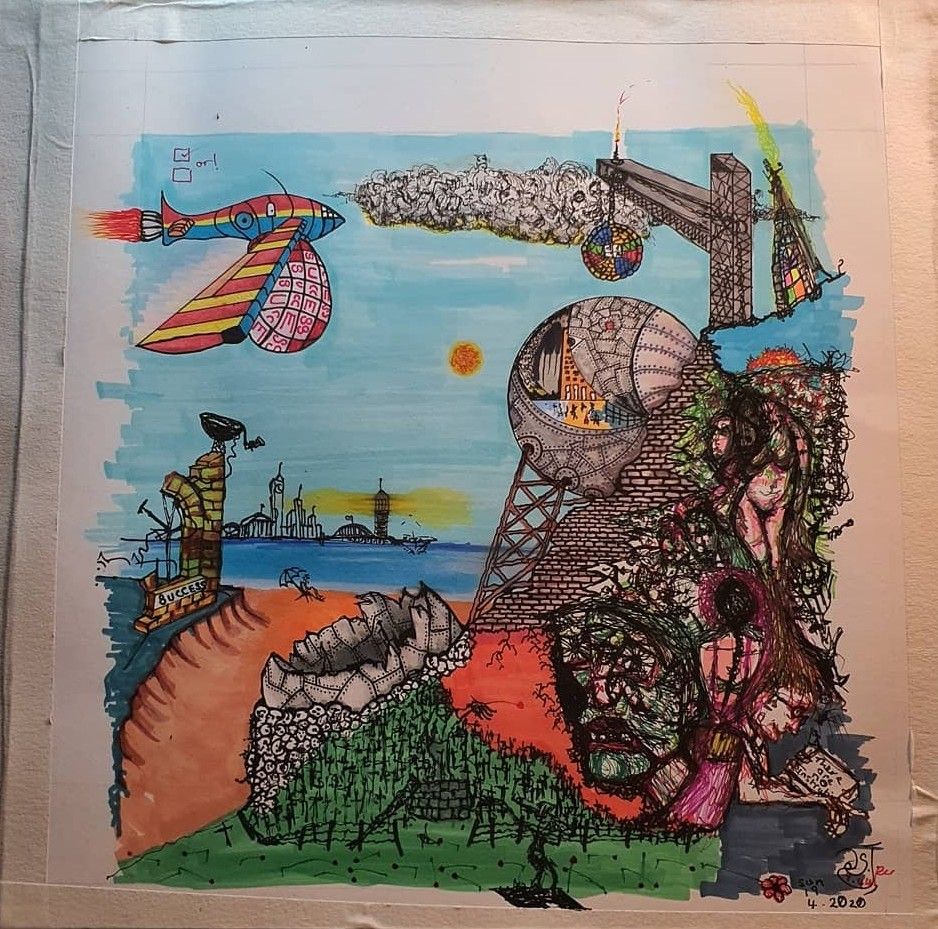
Drawing by @steriojoe.
(Shine those shiny shoes boy!)
Write a full, in-depth interpretation of poem and image.
This work, “The Fool (Book 0),” presents a visceral critique of corporate ambition, industrial greed, and the systemic stifling of the human spirit. Drawing on the Tarot archetype of “The Fool”—traditionally representing new beginnings and naivety—the artist recontextualizes it as a warning against chasing a “hollow” success.
1. Visual Analysis: A Landscape of Fractured Ambition
The drawing is a dense, surrealist collage that contrasts mechanical rigidness with organic chaos.
- The “Success” Vessel: In the upper left, a rainbow-colored flying machine carries a heavy cargo pod labeled “SUCCESS.” This represents the “naive want” mentioned in the poem—a colorful, attractive vehicle fueled by a single-minded goal.
- The Industrial Machine vs. Nature: On the right, we see metallic spheres, industrial cranes, and brick walls. These represent the “castles built to eat the sky.” Below them, the imagery turns darker and more organic, with tangled faces and figures that seem trapped or “painted in blood,” suggesting the human cost of industrial progress.
- The Grave and the Green: The bottom left features a field of crosses or markers, perhaps representing the “crushing of life” or the death of creative meaning. However, it transitions into a green field, hinting at the “honeybees” and “fruit-bearing trees” mentioned in the poem’s hopeful turn.
- The Distant Horizon: A clean, idealized skyline sits across the water, representing the “clean style” and the unreachable “top” that the Fool endlessly pursues.
2. Literary Interpretation: The Naive vs. The Foolish
The poem functions as a narrative arc from blind ambition to a utopian longing, ending with a cynical warning.
The “Naive Want” and the Corporate Climb
The opening lines, “Face beaming with naive want / The top, the top its all about the top,” describe the initial stage of the Fool’s journey. The Fool isn’t malicious; they are simply blinded by the promise of status. The phrase “Building castles to eat the sky” is a powerful metaphor for overconsumption—man-made structures attempting to consume the infinite nature of the heavens.
The Death of Art
The line “That day artists stop painting in blood” suggests that currently, creativity is born of suffering, sacrifice, or “hustle culture.” The poem asks for a world where art isn’t a byproduct of pain, but a natural expression of a fulfilled life.
The Utopian Pivot
Midway through, the tone shifts to a dream of environmental and social restoration:
- Healing: “Time will give flowers back / For the honeybees.”
- Equity: “Every belly full regardless.” This section highlights the alternative to the “Success” vessel—a world of collaboration rather than competition.
The Final Warning
The closing stanza is a biting reversal. It suggests that the path to “success” is a trap laid by those who are “too fearful of change.” To follow the traditional path of “shining those shiny shoes” is to be a Fool who has been fooled into maintaining a broken status quo.
3. Synthesis: The Core Message
Together, the image and poem suggest that modern “Success” is a manufactured illusion. The “Fool” is anyone who believes that the “Top” provides fulfillment. The artist argues that while we are busy building mechanical spheres and filling cargo pods with the word “Success,” we are crushing the very things that sustain us: nature, collaborative spirit, and authentic creativity.
The piece is a call to “throw away hate” and “angry threats” in favor of a world that prioritizes the “belly” (basic needs) and the “honeybees” (ecology) over the “clean walls” of corporate hierarchy.
 steriojoe2025 featuring AI Gemini
Leave a comment